GEOTECHNICALENGINEERING
GILBERT
HomeLaboratoryTriaxial test

Triaxial Testing in Gilbert — Shear Strength Parameters for Foundation Design

Geotechnical engineering with regional judgment.

LEARN MORE

ASCE 7 and the IBC require site-specific shear strength data when designing foundations in the Phoenix Basin, and Gilbert’s soil profile makes this particularly critical. Much of Gilbert sits on deep alluvial deposits where cemented sands and caliche layers create distinct strength horizons that standard penetration testing cannot fully characterize. When a project involves retaining structures deeper than six feet or footings on slopes above 5 percent — common conditions in subdivisions near the San Tan Mountains — the triaxial test provides the drained and undrained parameters engineers need to size foundations conservatively. Our laboratory runs consolidated-undrained (CU) and consolidated-drained (CD) triaxial tests on undisturbed Shelby tube samples extracted from depths reaching 40 feet. For sites in the Heritage District undergoing redevelopment, where older fill soils overlie natural desert pavement, the triaxial test often reveals strength contrasts that a CPT test alone cannot resolve. We schedule specimen preparation within 48 hours of sample delivery because contractors working under Gilbert’s summer construction windows cannot afford lab delays. The equipment runs 24-hour saturation cycles when soils exhibit low permeability, ensuring backpressure saturation reaches Skempton’s B parameter above 0.95 before the shear stage begins.

A triaxial test on an undisturbed sample from depth yields the friction angle and cohesion that turn a generic presumptive bearing value into a defensible, site-specific foundation design.
Our service areas

Our approach and scope

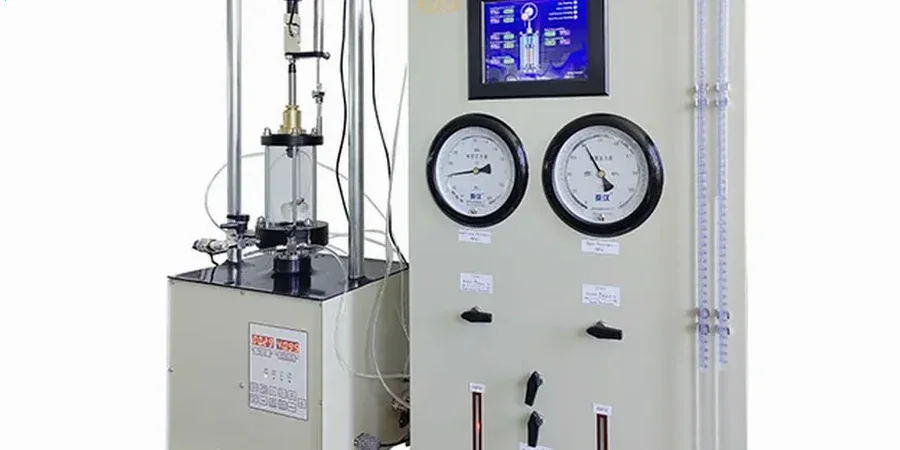
The triaxial cell in our Gilbert facility is a servo-controlled system running a 10,000 lbf load frame with digital volume-change measurement and pore pressure transducers calibrated weekly. Specimens are trimmed to 2.8-inch diameter from 3-inch Shelby tubes and mounted inside a latex membrane before the cell is filled with de-aired water. Confining pressures are selected based on the overburden depth at the sampling point — typically 15, 30, and 45 psi for most residential and light commercial projects east of Loop 202. During the consolidation phase, the system records volume change at 0.1-second intervals, and the operator confirms that primary consolidation is complete before initiating shear at a strain rate slow enough to allow pore pressure equalization — usually 0.05% per minute for low-permeability silts. The test generates a Mohr-Coulomb failure envelope from three specimens, giving the effective friction angle and cohesion intercept that structural engineers plug directly into bearing capacity equations. For projects where groundwater fluctuation is a concern, we pair the triaxial data with Atterberg limits to assess how seasonal moisture changes might reduce effective stress in expansive clay lenses found throughout the Gilbert area. Every triaxial report includes the stress-strain curves, p-q diagrams, and the interpreted failure envelope with the correlation coefficient for the Mohr-Coulomb fit, because transparency in lab data helps the geotechnical engineer defend their design parameters during plan review at the Town of Gilbert Building Safety Division.
Triaxial Testing in Gilbert — Shear Strength Parameters for Foundation Design
Technical reference — Gilbert

Local geotechnical context

The mistake we see contractors make repeatedly in Gilbert is commissioning a triaxial test but sending remolded or disturbed samples from shallow auger cuttings instead of undisturbed Shelby tubes from the design depth. A remolded specimen loses the soil’s natural structure, cementation, and stress history — and the resulting friction angle can be 3 to 5 degrees lower than the in-situ value, driving foundation dimensions upward by 15 to 20 percent unnecessarily. Another common error is running only unconfined compression tests on cohesive soils and assuming the undrained shear strength equals half the UCS value, which breaks down when the soil contains sand lenses or caliche nodules that create drainage paths during shear. The triaxial test with pore pressure measurement eliminates that assumption by directly measuring the effective stress state at failure. For sites within Gilbert’s designated liquefaction hazard zones — primarily along the old Salt River paleochannels — the cyclic triaxial test gives the liquefaction resistance curve needed for a defensible seismic settlement analysis, which the Town may request during the grading permit review for any structure classified as Risk Category III or IV per IBC Table 1604.5.

Need a geotechnical assessment?

Reply within 24h.

Email: info@geotechnicalengineering.sbs

Explanatory video

Applicable standards

ASTM D4767-11: Standard Test Method for Consolidated Undrained Triaxial Compression Test for Cohesive Soils, ASTM D7181-20: Standard Test Method for Consolidated Drained Triaxial Compression Test for Soils, ASTM D4220: Standard Practices for Preserving and Transporting Soil Samples, ASCE 7-22: Minimum Design Loads and Associated Criteria for Buildings and Other Structures (Chapter 20, Geotechnical Site Investigation), IBC 2021: Section 1803 — Geotechnical Investigations (adopted by Town of Gilbert)

Technical parameters

ParameterTypical value
Test types availableCU (consolidated-undrained), CD (consolidated-drained), UU (unconsolidated-undrained)
Specimen diameter2.8 in (trimmed from 3-inch Shelby tube)
Maximum confining pressure150 psi (up to 100 ft overburden equivalent)
Shear strain rate (CU/CD)0.05 to 0.10% per minute, adjusted for soil permeability
Backpressure saturation targetSkempton B parameter ≥ 0.95
Reporting parametersEffective friction angle φ', cohesion c', stress-strain curves, p-q diagrams
ASTM standardASTM D4767 (CU), ASTM D7181 (CD)
Sample turnaround5 to 7 business days from sample delivery for standard CU triaxial suite

Questions and answers

What does a triaxial test cost for a typical residential project in Gilbert?

A standard CU triaxial suite — three specimens from the same Shelby tube, tested at three confining pressures — generally runs between US$1,610 and US$2,830, depending on whether the soil is fine-grained (longer saturation and shear time) or granular, and whether drained (CD) or undrained (CU) conditions are required. The price includes specimen trimming, saturation monitoring, consolidation, shear, and the complete report with Mohr-Coulomb failure envelope. Cyclic triaxial testing for liquefaction assessment is priced separately due to the extended test duration and specialized equipment configuration.

How long does it take to get triaxial test results in Gilbert?

For a CU triaxial suite on silty or clayey soils typical of Gilbert, the standard turnaround is five to seven business days from sample delivery. The timeline breaks down as follows: specimen trimming and setup on day one, saturation and consolidation over the next 24 to 48 hours (longer for low-permeability clays), and the shear stage requiring roughly 8 to 12 hours per specimen at the slow strain rates required by ASTM D4767. Drained (CD) tests add one to two days because the shear rate must be even slower to maintain zero excess pore pressure. We can expedite to four business days when the project schedule demands it, provided the soils are not extremely low-permeability.

What sample quality is needed for a reliable triaxial test?

The triaxial test requires undisturbed samples obtained by thin-walled Shelby tube (ASTM D1587) or by block sampling in test pits. The sample must be properly sealed with wax or plastic caps immediately upon extrusion in the field, stored upright, and protected from vibration and temperature extremes during transport. Disturbed bag samples or SPT split-spoon samples cannot yield valid triaxial results because the soil structure, density, and natural moisture content are lost during the sampling process. For Gilbert’s cemented sands, we recommend using a pitcher barrel sampler or a Denison sampler, as the Shelby tube may not penetrate the caliche horizons without damaging the specimen.

Which triaxial test type does my Gilbert project need — CU, CD, or UU?

The choice depends on the design scenario: CU (consolidated-undrained) with pore pressure measurement is the default for most foundation and retaining wall designs because it provides effective stress parameters φ' and c' for both short-term and long-term analysis. CD (consolidated-drained) is specified for long-term slope stability studies where drained conditions govern, as is the case for permanent cut slopes in Gilbert’s alluvial soils. UU (unconsolidated-undrained) is rarely used for final design but can serve as a quick screening test during preliminary investigations. The geotechnical engineer of record should specify the test type and confining pressure range based on the expected loading conditions and the depth of the foundation elements.

Location and service area

We serve projects in Gilbert and surrounding areas.

View larger map