GEOTECHNICALENGINEERING
GILBERT
HomeRoadwayFlexible pavement design

Flexible Pavement Design and Geotechnical Verification in Gilbert, AZ

Geotechnical engineering with regional judgment.

LEARN MORE

Gilbert sits on the eastern edge of the Salt River Valley, where the subsurface swings from wind-deposited silts to pockets of hard caliche and expansive clay layers that wreck pavement joints if you get the base wrong. The old agricultural grid left behind irrigation pinholes and soft zones that don't show up until a pavement section starts rutting two summers in. We run the full subgrade sequence — CBR testing for soaked strength, soil classification per ASTM D2487, and Proctor compaction curves — before a single lift of asphalt goes down. Our lab crew has worked on Town of Gilbert commercial pads, HOA access roads, and Maricopa County arterial widenings, so we know how the native soil reacts under repeated axle loads when daytime temperatures top 110°F. We tie the structural number and layer coefficients directly to the AASHTO 93 flexible pavement equation, not a generic catalog pick, because the mix of sandy gravel lenses and fat clay pockets across the 85233-to-85298 corridor demands a block-by-block approach.

In Gilbert, a pavement section lives or dies by what sits beneath the asphalt — getting the subgrade modulus right saves a full-depth reclamation five years later.
Our service areas

Our approach and scope

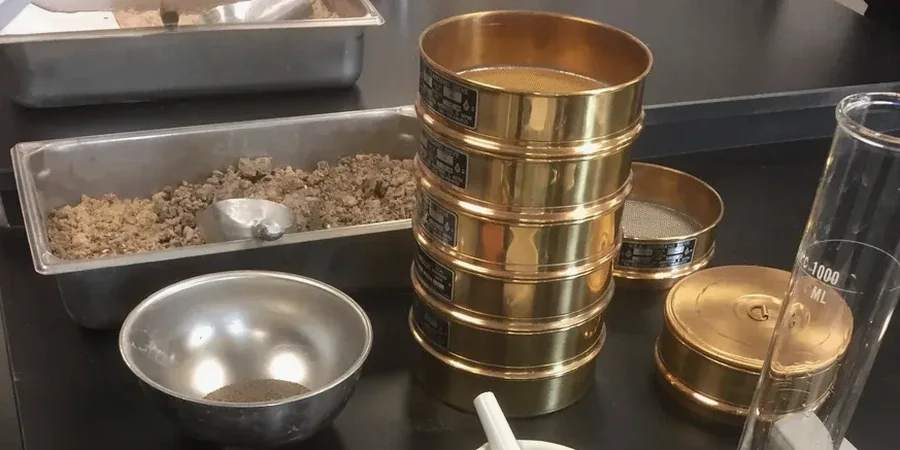
The Town of Gilbert adopts Maricopa County DOT standards and references AASHTO 1993/1998 for structural design, but the real challenge is Arizona's thermal swing — 40°F nights to 115°F afternoons create tensile strain at the bottom of the asphalt layer that standard national charts don't fully capture. Our approach layers resilient modulus backcalculation from plate load testing onto the pavement cross-section, so the granular base thickness accounts for seasonal moisture migration into the subgrade. We test aggregate base per ASTM D2940 and verify gradation with washed sieve analysis, because gap-graded AB fails early under channelized traffic in retail plazas. For subdivision streets with shallow groundwater near the Eastern Canal, we specify lime treatment percentages based on pH and Eades-Grim tests, then confirm with CBR soaked values above 20 before the paving crew mobilizes. Every design package leaves the lab with a signed subgrade evaluation report, layer profile, and the design ESALs justified for the project traffic forecast.
Flexible Pavement Design and Geotechnical Verification in Gilbert, AZ
Technical reference — Gilbert

Local geotechnical context

On the east side of Gilbert, we repeatedly encounter a scenario where a contractor places AB over dry caliche, achieves density, and six months later the pavement reflects every fracture line because the caliche softened under irrigation runoff. Another common failure is rutting along the wheel paths of collector streets where the structural number was calculated with an optimistic CBR from a dry sample — once the monsoon raises the water table under the Hunt Highway corridor, the soaked strength drops by half and the asphalt starts shoving. Expansive clay lenses near the Riparian Preserve create longitudinal heave cracks when the subgrade moisture content fluctuates between summer and winter. These failures are preventable with a layer-specific design that accounts for moisture sensitivity. By pairing soaked CBR with resilient modulus estimates and selecting the correct asphalt binder grade for the Phoenix Metro temperature profile, we eliminate the guesswork that leads to premature overlay cycles and angry HOA boards.

Need a geotechnical assessment?

Reply within 24h.

Email: info@geotechnicalengineering.sbs

Explanatory video

Applicable standards

AASHTO 1993 Guide for Design of Pavement Structures, ASTM D1883 Standard Test Method for California Bearing Ratio (CBR) of Laboratory-Compacted Soils, ASTM D2940 Standard Specification for Graded Aggregate Material for Bases or Subbases, ASTM D2487 Standard Practice for Classification of Soils for Engineering Purposes, MAG Uniform Standard Specifications for Public Works Construction (Maricopa Association of Governments)

Technical parameters

ParameterTypical value
Design methodologyAASHTO 1993/1998 flexible pavement structural number (SN)
Subgrade strength indexASTM D1883 soaked CBR at 0.1-inch penetration
Base course specificationASTM D2940 / MAG 702 gradation with PI < 4
Stabilization verificationEades-Grim pH test + UCS after 7-day moist cure
Asphalt binder gradePG 70-10 or PG 76-16 per ADOT / local climate zone
Traffic loading inputDesign ESALs derived from trip generation or ADT count
Compaction controlNuclear gauge density per ASTM D6938, 95% modified Proctor
Caliche layer treatmentRipping depth + moisture conditioning before compaction

Questions and answers

What does flexible pavement design cost for a typical commercial site in Gilbert?

For a commercial pad or small subdivision street section in Gilbert, a complete subgrade evaluation with pavement thickness design runs between US$1,440 and US$4,960 depending on the number of borings, the lab testing suite required, and whether lime or cement stabilization mix designs are needed.

Which standard does the Town of Gilbert accept for pavement structural design?

The Town of Gilbert and Maricopa County DOT reference the AASHTO 1993/1998 flexible pavement design method, supplemented by MAG uniform standards. We prepare the structural number calculation, design ESALs, and layer coefficient justification in the format planning departments expect.

How do you handle caliche layers under proposed pavement in Gilbert?

Caliche requires careful moisture conditioning and full-depth ripping before compaction. We test the broken material for gradation and plasticity, recompact to 95% of modified Proctor, and verify soaked CBR before the aggregate base goes down. If the caliche layer is too thick or fractured, we may specify an increased base thickness or a geogrid separation layer.

What binder grade do you recommend for asphalt in the Phoenix heat?

For Gilbert's climate zone, ADOT typically specifies PG 70-10 for standard applications and PG 76-16 for high-stress intersections or bus stops. We confirm the binder grade against the project traffic level and the anticipated pavement temperature range using LTPPBind software.

Do you need traffic counts for a pavement design?

Yes, design ESALs are the backbone of the AASHTO structural number equation. For a retail center or apartment complex, we can estimate ESALs from ITE trip generation data. For public streets, we request ADT counts from the Town of Gilbert traffic engineering division or use project-specific traffic impact study numbers.

Location and service area

We serve projects in Gilbert and surrounding areas.

View larger map