GEOTECHNICALENGINEERING
GILBERT
HomeLaboratoryLaboratory CBR test

Laboratory CBR Testing for Pavement and Subgrade in Gilbert, AZ

Geotechnical engineering with regional judgment.

LEARN MORE

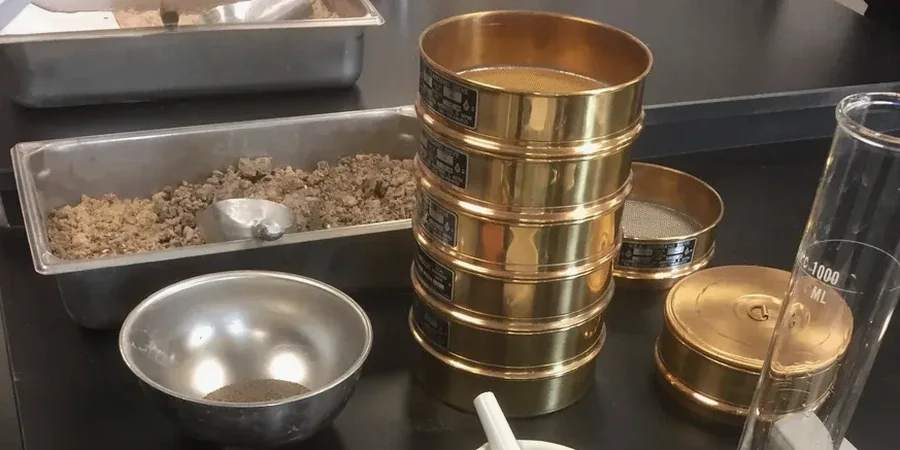
ADOT specs on the Loop 202 extension required soaked CBR values above 8% for the subbase. The contractor brought in samples from a pit near Higley Road. We tested them at three compaction levels in our lab. The material passed at 98% modified Proctor, but barely. That 0.5% difference meant the difference between acceptance and a full cement stabilization redesign. Our laboratory CBR test gives you that number before the paver moves in. We follow ASTM D1883 procedure, preparing remolded specimens at optimum moisture content and soaking them for 96 hours. For projects near the Gilbert Regional Park where clayey sands dominate, we often pair the CBR with a grain-size analysis to verify fines content before compaction. Results are ready in three to five working days. No guesswork. Just a penetration curve and a number that your pavement design depends on.

A soaked CBR value below 5% in Gilbert means you are looking at a subgrade failure within two monsoon seasons.
Our service areas

Our approach and scope

The most common mistake we see in the East Valley is testing CBR at field moisture without soaking. Gilbert's summer monsoons change everything. A dry sample might show CBR of 25%. After four days of soaking, that same material drops to 4%. That is a failed subgrade. Our lab procedure always includes the soaked condition as required by AASHTO and ADOT. We use a mechanical loading press with a penetration rate of 0.05 inches per minute, recording load at 0.1- and 0.2-inch penetration. The corrected stress is compared to standard crushed stone values. For sites near the San Tan Freeway corridor where imported fill is common, we recommend running a sand cone density test in the field and comparing it against our lab compaction curve. That way, field density and lab strength align. The correlation saves thousands in over-excavation.
Laboratory CBR Testing for Pavement and Subgrade in Gilbert, AZ
Technical reference — Gilbert

Local geotechnical context

Gilbert sits at 1,237 feet elevation on the edge of the Sonoran Desert. The soil here is not just sand. It is layered. Loose alluvium over cemented caliche over expansive clay pockets. We have seen pavement sections fail within two years because the CBR was estimated from a visual classification instead of tested. A low CBR subgrade under a rigid pavement slab leads to pumping, faulting, and corner breaks. Under flexible pavement, you get alligator cracking and rutting after one hot summer. The IBC and ASCE 7 require a site-specific geotechnical investigation for any public right-of-way project. ADOT Standard Specifications Section 203 explicitly calls for laboratory CBR on subgrade and base course. Skipping the test to save two weeks is not worth the risk. We test for the monsoon season, not for the dry week of sampling.

Need a geotechnical assessment?

Reply within 24h.

Email: info@geotechnicalengineering.sbs

Applicable standards

ASTM D1883: Standard Test Method for California Bearing Ratio (CBR) of Laboratory-Compacted Soils, ASTM D1557: Standard Test Methods for Laboratory Compaction Characteristics of Soil Using Modified Effort, IBC 2021: Section 1803 Geotechnical Investigations, ASCE 7-22: Minimum Design Loads and Associated Criteria for Buildings and Other Structures, ADOT Standard Specifications Section 203: Roadway Excavation and Embankment

Technical parameters

ParameterTypical value
Test standardASTM D1883
Specimen preparationRemolded at optimum moisture (ASTM D1557)
Soaking period96 hours submerged
Penetration rate0.05 in/min (1.27 mm/min)
Key readingsCBR 0.1″ and CBR 0.2″
Swell measurementPercent swell during soaking
Compactive effortStandard or modified Proctor
Typical turnaround3–5 working days

Questions and answers

What does a laboratory CBR test in Gilbert cost?

A standard soaked CBR test on one sample typically ranges from US$130 to US$200, depending on whether you need a single-point or three-point compaction curve. The package that includes a modified Proctor and three CBR points sits at the upper end. We recommend testing at least two samples per soil type on your site.

Why does ADOT require soaked CBR instead of unsoaked?

Because the monsoon season in Maricopa County saturates the subgrade. A dry sample gives a false high CBR. Soaking for 96 hours simulates the worst-case moisture condition your pavement will see over its design life. ADOT and MCDOT both require the soaked value for pavement thickness design using the AASHTO 1993 method.

How much material do you need for a CBR test?

About 110 lb of disturbed material per sample for a modified Proctor plus CBR package. The material must be representative of the subgrade or base course you are testing. We provide sampling bags and instructions. You can drop the sample at our lab, or we can coordinate field sampling with one of our technicians.

Location and service area

We serve projects in Gilbert and surrounding areas.

View larger map