GEOTECHNICALENGINEERING
GILBERT
HomeSeismicBase isolation seismic design

Base Isolation Seismic Design for Critical Structures in Gilbert, Arizona

Geotechnical engineering with regional judgment.

LEARN MORE

Gilbert sits in a region where the seismic conversation often gets overlooked—until the ground moves. The 1887 Sonoran earthquake, a magnitude 7.6 event centered in northern Mexico, sent shockwaves that were felt across the Salt River Valley, including what is now Gilbert’s town limits. With the town’s population now exceeding 270,000 and major healthcare, education, and data-center projects rising along the Loop 202 corridor, the demand for base isolation seismic design has moved from a niche topic to a core resilience requirement. Our team works with projects where operational continuity after an earthquake is non-negotiable. Understanding the interaction between the stiff caliche layers and deeper basin sediments common in southeast Gilbert means we don’t apply a generic isolator catalog—we engineer each system to the subsurface reality. When a liquefaction assessment reveals loose silty sands at depth, the isolation strategy must account for potential settlement and lateral spread, not just spectral acceleration at the ground surface.

Base isolation in the Gilbert basin requires matching the isolator’s period to the deeper basin response—the stiff caliche cap often masks the softer sediments that control long-period amplification.

Our service areas

Our approach and scope

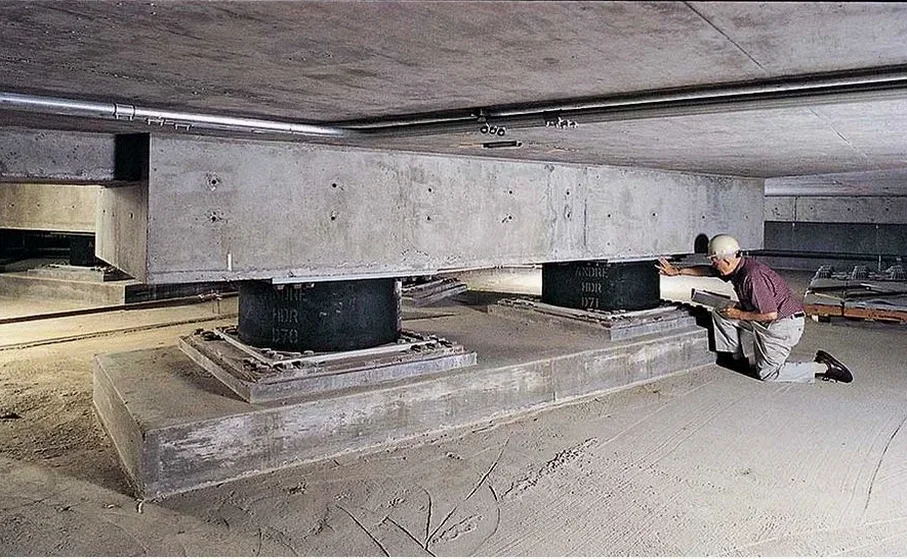
On a recent medical office building near the Banner Gateway Medical Center, the structural engineer called us in after preliminary SPT values showed a sharp impedance contrast at 18 feet—dense gravel over softer alluvial clay. That’s a classic situation where fixed-base acceleration would concentrate drift in the lower stories. We modeled a hybrid base isolation seismic design with lead-rubber bearings and supplementary viscous dampers, targeting a 2.8-second effective period to push the structure well past the predominant site period of 0.6 seconds measured from a downhole array. The isolator displacement demand came out to 14 inches under the design earthquake, well within the clearance we detailed for the moat wall. Before finalizing the bearing layout, we ran a CPT test at each column line to refine the stiffness profile and confirm the absence of a softer lens that would have altered the rocking stiffness of the mat foundation. The project is now the first base-isolated essential facility in town, and the peer review panel commended the site-specific ground-motion selection that drew from both the NGA-West2 database and local recordings from the AZ Integrated Seismic Network.
Base Isolation Seismic Design for Critical Structures in Gilbert, Arizona
Technical reference — Gilbert

Local geotechnical context

The south end of Gilbert overlies the Queen Creek basin margin, where the depth to the crystalline basement transitions from roughly 2,000 feet to over 8,000 feet across a buried fault step. That geometry creates a basin-edge effect: surface waves generated at the impedance boundary reflect and superimpose, producing longer-duration shaking and amplified spectral accelerations at periods between 1.5 and 3.0 seconds. For a base-isolated structure tuned to that period range, the risk is not just higher isolator displacement but a potential resonance condition if the basin’s fundamental frequency shifts during strong shaking due to nonlinear soil behavior. We’ve seen similar patterns in recordings from the 2019 Ridgecrest earthquakes, where basin sites in the Coachella Valley sustained shaking durations 40% longer than rock sites at comparable distances. In Gilbert, ignoring this phenomenon means an isolation system designed to ASCE 7 uniform-hazard spectra could under-predict displacement by 30% or more. Our approach incorporates equivalent-linear site response with basin amplification factors drawn from the SCEC Community Velocity Model, ensuring the moat wall isn’t just code-compliant—it’s sized for the actual ground-motion footprint this basin produces.

Need a geotechnical assessment?

Reply within 24h.

Email: info@geotechnicalengineering.sbs

Applicable standards

ASCE/SEI 7-22 Minimum Design Loads and Associated Criteria for Buildings and Other Structures, IBC 2024 Section 1705.17 – Special Inspections and Tests for Seismic Isolation Systems, ISO 22762-1:2018 Elastomeric Seismic-Protection Isolators – Test Methods, AASHTO Guide Specifications for Seismic Isolation Design, 4th Edition, ASTM D4015 – Standard Test Methods for Modulus and Damping of Soils by the Resonant-Column Method

Technical parameters

ParameterTypical value
Design basis ground motion (DBGM)ASCE 7-22 Chapter 11 – Site Class D default, refined with site-specific response analysis
Effective isolator period (lead-rubber bearing)2.5 s to 3.2 s for typical 3–6 story structures on alluvial soil profiles
Maximum considered earthquake (MCE) displacement demand10 in. to 18 in. depending on near-fault factor and basin depth
Minimum moat clearanceMCE displacement + 20%, or 6 in. absolute minimum per IBC Section 1705.17
Property modification factors (λ)λ_max = 1.3 for elastomeric bearings; λ_min = 0.8 per AASHTO Guide Specifications
Concurrent vertical load capacityTypically 400 kip to 2,200 kip per isolator, verified by prototype testing per ISO 22762
Post-earthquake residual displacement criteria< 30% of MCE displacement under gravity restoring force, checked via nonlinear time history

Questions and answers

What makes base isolation different from traditional seismic design in Gilbert?

Traditional fixed-base design accepts structural damage as the energy dissipation mechanism—beams yield, walls crack, and the building survives but may be unusable afterward. Base isolation seismic design decouples the structure from the ground motion using flexible bearings and dampers, so the superstructure remains essentially elastic. In Gilbert’s basin setting, where long-period amplification can extend shaking duration by 15–40 seconds, isolation shifts the fundamental period well past the damaging range and reduces floor accelerations by 50–70% compared to a fixed-base equivalent.

How much does a base isolation system add to project cost?

For a mid-rise essential facility in Gilbert, the incremental cost of the isolation system—including bearings, moat wall, flexible utility connections, and special inspection—typically falls between US$3,910 and US$8,930 per isolator in material and testing, with the total system cost depending on the number of bearings and the displacement demand. When weighed against post-earthquake downtime, inventory loss, and business interruption for a critical-use structure, the lifecycle cost advantage is substantial and often required by the owner’s resilience policy.

Which IBC seismic design category triggers base isolation consideration in Gilbert?

Gilbert falls within Seismic Design Category C or D depending on the site class, per the USGS National Seismic Hazard Model and ASCE 7-22. Base isolation becomes a strong candidate for Risk Category IV structures (hospitals, emergency response centers, data centers) in SDC D, and for any Risk Category III or IV building where the owner requires immediate occupancy after the design earthquake. IBC Section 1705.17 mandates special inspection and testing for all isolated structures regardless of the design category.

How do you verify that the isolators will perform as designed over the building’s life?

Every isolator undergoes prototype testing—three fully reversed cycles at MCE displacement, plus aging and creep tests per ISO 22762—before production begins. During production, we test a statistically significant sample of bearings to confirm shear stiffness and damping within the λ-factor bounds specified by ASCE 7. Post-installation, the IBC requires a special inspection program that includes verifying bearing placement, moat clearance, and flexible utility connections before the certificate of occupancy is issued.

Can an existing building in Gilbert be retrofitted with base isolation?

Yes, though it’s more complex than a new-build application. The process involves temporarily supporting the structure on jacking columns, cutting the existing columns at the isolation plane, and inserting the bearings. We’ve evaluated several retrofit feasibility studies for unreinforced masonry and non-ductile concrete buildings in the Phoenix metro area. The primary challenges are maintaining vertical load path continuity during the jacking sequence and detailing the new moat wall around existing utilities. A detailed seismic microzonation study helps quantify the retrofit benefit by mapping the site-specific demand before committing to the structural modifications.

Location and service area

We serve projects in Gilbert and surrounding areas.

View larger map