GEOTECHNICALENGINEERING
GILBERT
HomeIn-Situ TestingField density test (sand cone method)

Field Density Testing in Gilbert, AZ – Sand Cone & Nuclear Methods

Geotechnical engineering with regional judgment.

LEARN MORE

ASTM D1556 and AASHTO T 191 govern field density verification across Arizona, but in Gilbert the real challenge isn't the standard—it's the soil. Much of the town sits on a patchwork of caliche layers, expansive clay lenses, and old agricultural land that was flood-irrigated for decades. When a contractor hits refusal at 18 inches on a Tuesday and then sinks a probe four feet the next lot over, you learn fast that textbook compaction doesn't always apply. That's why our field density testing goes beyond the nuclear gauge reading. We correlate moisture content with lab Proctor curves, and for deeper lifts where the sand cone is impractical we pair the results with SPT drilling data to confirm that what we're measuring at the surface actually holds at depth. The Town of Gilbert Engineering Division won't sign off on a pad certification without clean numbers, and neither will the geotechnical engineer of record. We get that.

A passing nuclear gauge reading in caliche float can be misleading—correlation with a sand cone test is the only way to be sure the number stands up.
Our service areas

Our approach and scope

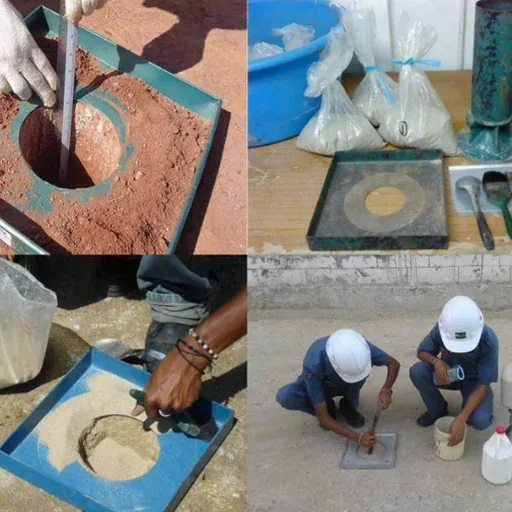
Gilbert's climate throws two extremes at compaction work: bone-dry summers where fill desiccates before it can be rolled, and intense monsoon bursts that can oversaturate a lift in 20 minutes. Our field density protocols adjust for both. The sand cone test remains the referee method—we use calibrated Ottawa sand that meets AASHTO T 191 gradation requirements, and every cone assembly gets checked against a reference base plate before site deployment. For large subdivision pads south of the 202 where production speed matters, nuclear gauges running ASTM D6938 give us real-time wet density and moisture within seconds, letting the grading contractor adjust passes on the fly. But when readings border on failing, we switch to the sand cone for the official record. We also coordinate with the materials lab on Proctor curve development because a curve built from poorly representative borrow material will doom every density test that follows. On sites with mixed caliche fill, we sometimes run modified Proctor values 10 to 15 percent higher than standard—if you don't account for that upfront, you'll be chasing a compaction percentage that the material never had a chance of reaching.
Field Density Testing in Gilbert, AZ – Sand Cone & Nuclear Methods
Technical reference — Gilbert

Local geotechnical context

Gilbert sits at roughly 1,243 feet elevation on the eastern edge of the Salt River Valley, and its soils are a geologist's puzzle—Casa Grande sandy loam in some sections, Mohall clay loam in others, and calcium carbonate cementation practically everywhere. The risk picture changes block by block. Over-excavate caliche without a proper density benchmark and you'll waste days chasing a number that the native material simply won't give you. Under-compact clay fill in a monsoon season and six months later you have differential settlement cracking through stucco. We've seen entire pad certs held up because the moisture was three points off optimum during a June heat wave—at 110°F, a sandy fill can lose two percent moisture between the water truck and the sheepsfoot roller. That's when field density testing stops being a checkbox and becomes a real-time construction control tool. We cross-check suspect readings with the sand cone method because in Gilbert's variable stratigraphy, the nuclear gauge occasionally reads high in organic-rich pockets or low over caliche float. Getting it wrong means rejected footings and a very expensive re-compaction cycle.

Need a geotechnical assessment?

Reply within 24h.

Email: info@geotechnicalengineering.sbs

Applicable standards

AASHTO T 191 – Density of soil in-place by the sand-cone method, ASTM D6938 – Standard test methods for in-place density and water content by nuclear methods, ASTM D1557 – Modified Proctor compaction test, Town of Gilbert Engineering Standards and Details (latest adopted edition)

Technical parameters

ParameterTypical value
Standard test methodAASHTO T 191 (sand cone) / ASTM D6938 (nuclear)
Minimum compaction threshold95% of max dry density per lab Proctor (ASTM D698 or D1557)
Sand calibrationOttawa 20-30 sand, bulk density verified per batch
Nuclear gauge modelTroxler 3440 or Humboldt 5001 series
Test frequency (fill pads)1 per 2,500 ft² per lift or as specified in geotechnical report
Acceptable moisture rangeOptimum ±2% (dry side) to optimum +4% (wet side) depending on plasticity

Questions and answers

What's the difference between a sand cone test and a nuclear density test in Gilbert?

The sand cone (AASHTO T 191) physically excavates a small hole, weighs the removed soil, and backfills with calibrated sand to measure volume directly. It's the referee method and doesn't rely on radiation. The nuclear gauge (ASTM D6938) gives a reading in under two minutes by measuring gamma ray backscatter and neutron moderation for moisture. In Gilbert's caliche-rich zones, the nuclear gauge can read artificially low in highly cemented layers or high in organic pockets, so we often run both methods as a correlation on the first few lifts of a project.

What compaction percentage does the Town of Gilbert require for building pads?

The Town of Gilbert Engineering Division generally requires 95% of the maximum dry density as determined by a modified Proctor (ASTM D1557) for structural fill under footings and slabs. Some commercial projects with heavy column loads or mat foundations may call for 98%. The exact threshold is always specified in the project's geotechnical report, which we reference before any field density test begins.

How much does a field density test cost in Gilbert?

For standard residential or commercial pad testing in Gilbert, our field density tests using the nuclear gauge typically run between $100 and $150 per test, depending on quantity and travel distance within the East Valley. Sand cone tests, which take longer and require more setup, fall in a similar range but may be quoted slightly higher when used as the primary method. We provide per-project pricing based on the number of lifts and required test frequency.

How soon after compaction can you test the lift?

Immediately, and that's the whole point of real-time field density testing. Once the roller has completed the specified number of passes, we can have a nuclear gauge reading in one to two minutes. If the fill is within the acceptable moisture range and density is at or above 95%, the contractor can start placing the next lift right away. The sand cone method takes about 15 to 20 minutes per test, so it's typically used for spot checks rather than production control.

Do you need a Proctor curve before running density tests in Gilbert?

Yes, absolutely. A field density number without a lab Proctor curve to compare it against is meaningless. The Proctor (ASTM D698 or D1557) tells us the maximum dry density and optimum moisture content for that specific borrow material. In Gilbert, where fill can come from on-site excavation through variable caliche and clay layers, we recommend running a new Proctor whenever the material source changes—otherwise you risk failing compaction on a curve that doesn't represent what's actually under the roller.

Location and service area

We serve projects in Gilbert and surrounding areas.

View larger map